
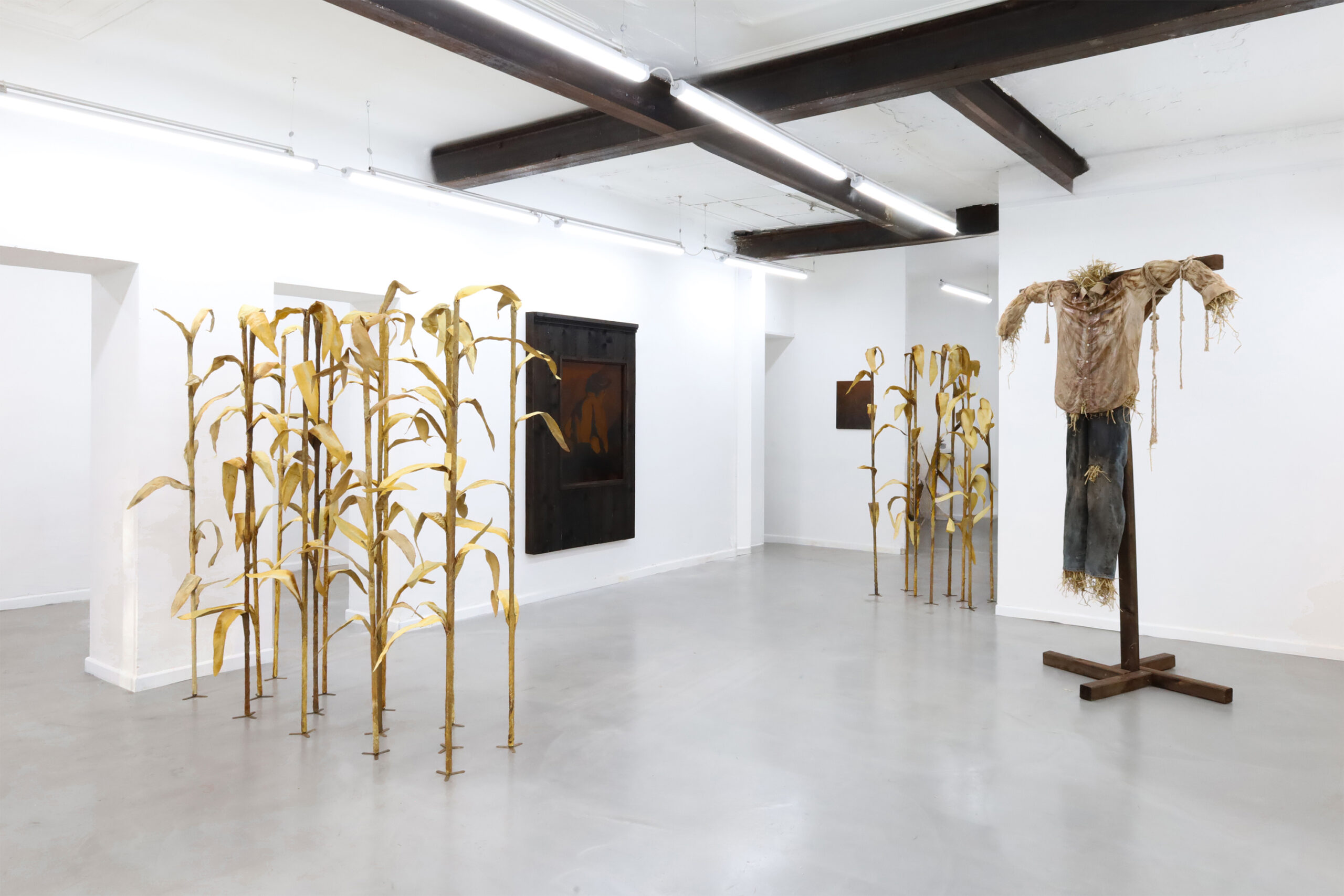
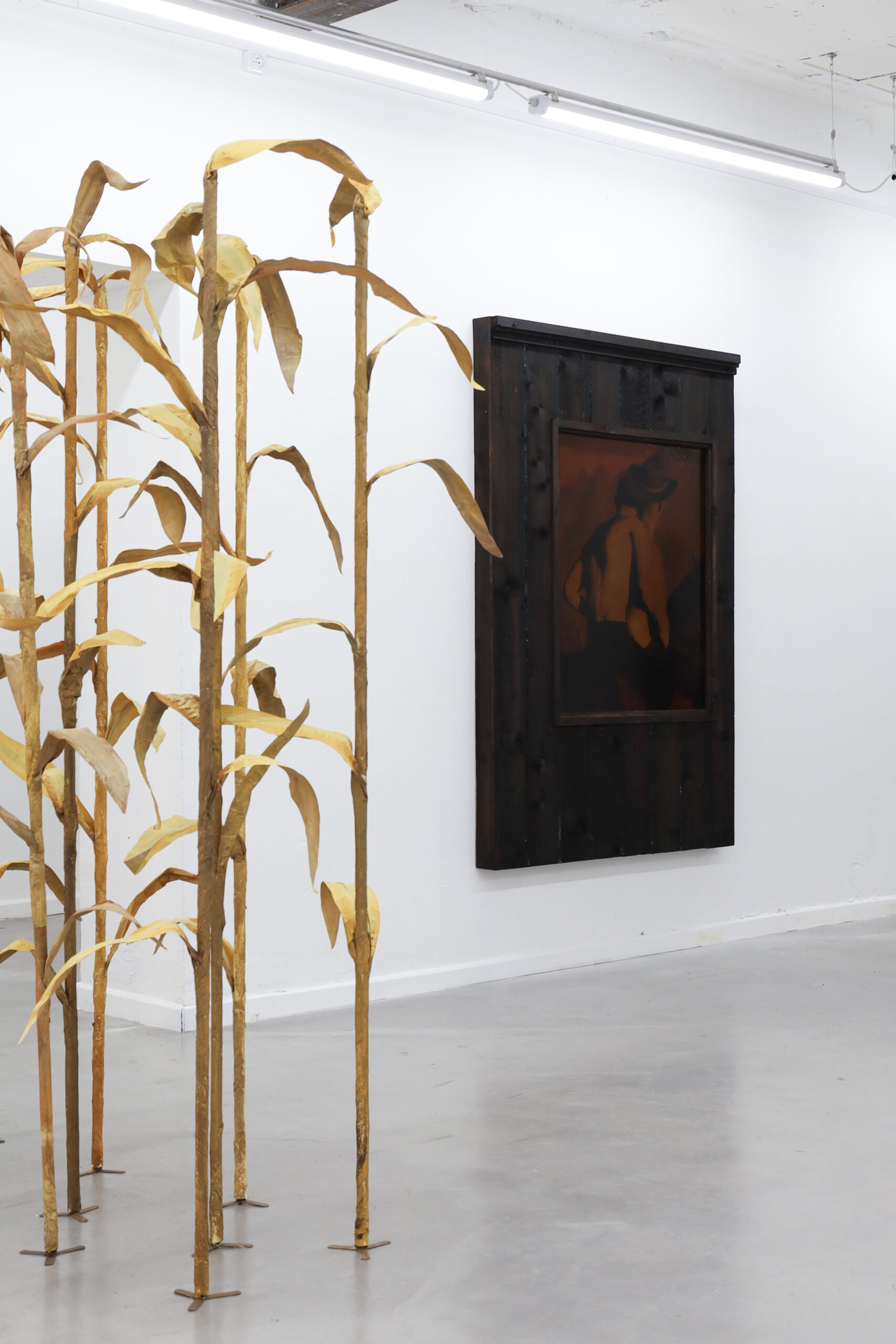
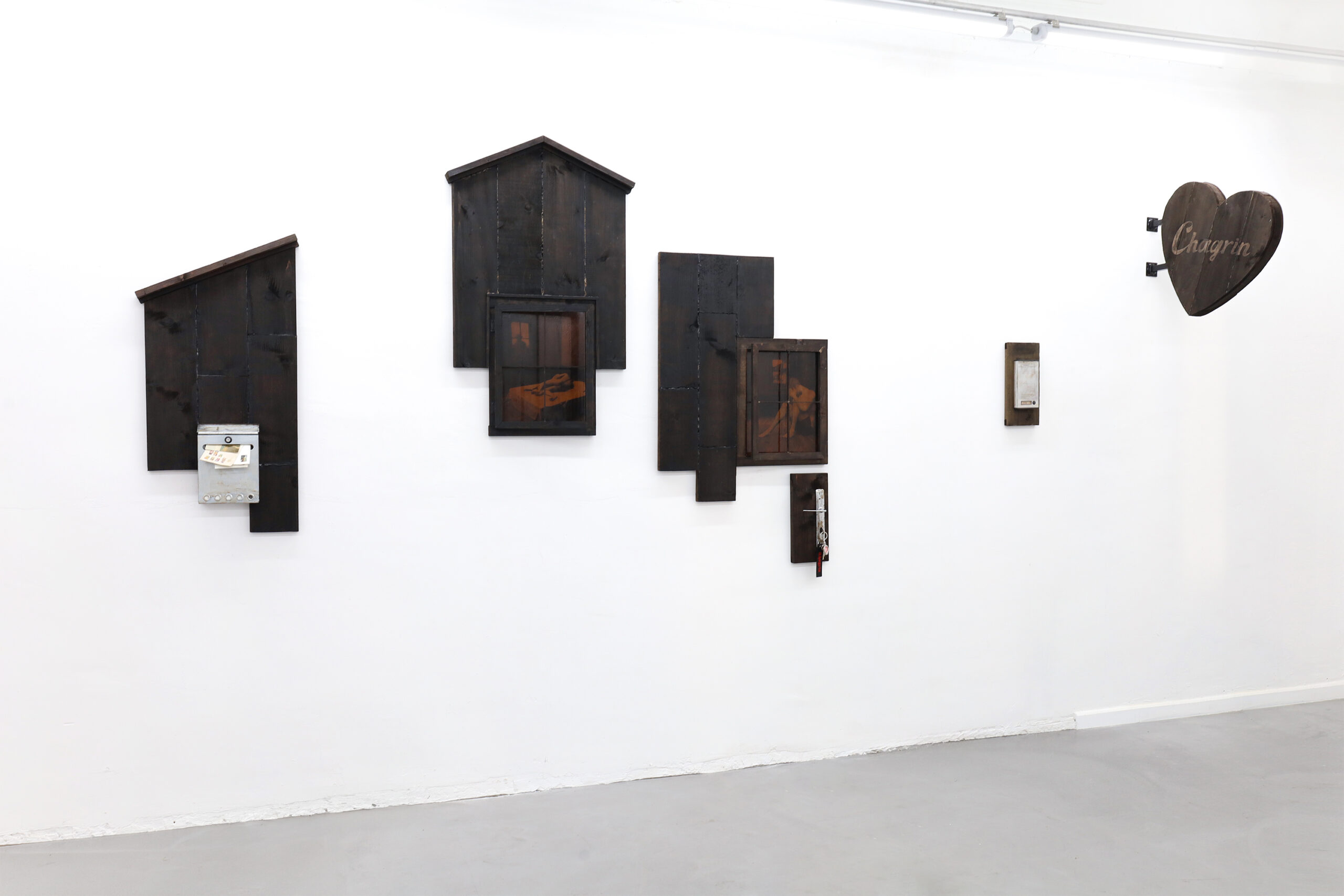
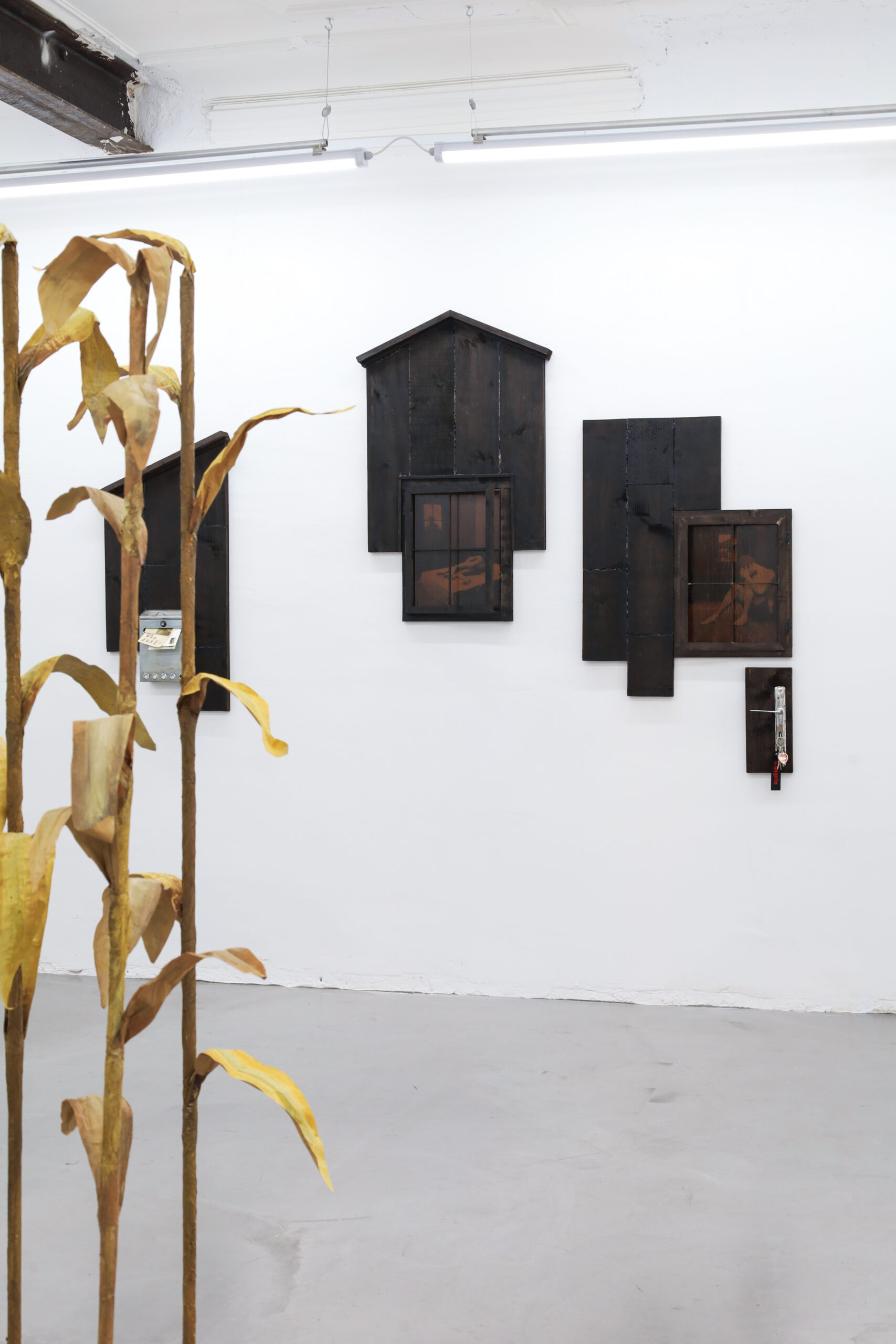
Corentin Darré creates installations that materialize an actantial schema within the exhibition. His sculptural works take the form of architectural elements — huts, pontoons, facades — like escaped spaces from fiction. Within these fragments, he inserts still and moving images, words and objects: items that indicate the narrative being played out, acting as a compass, a landmark and accompanying the visitor.
Corentin Darré tackles themes such as the hostility of human relationships, aggression, love and solitude, often explored through the lens of tragedy, the fate of cursed lovers. By hijacking the legends and figures that build the collective imagination, and reversing the destination of their moral warning, he invents new mythical representations and questions the world’s attitudes to otherness.
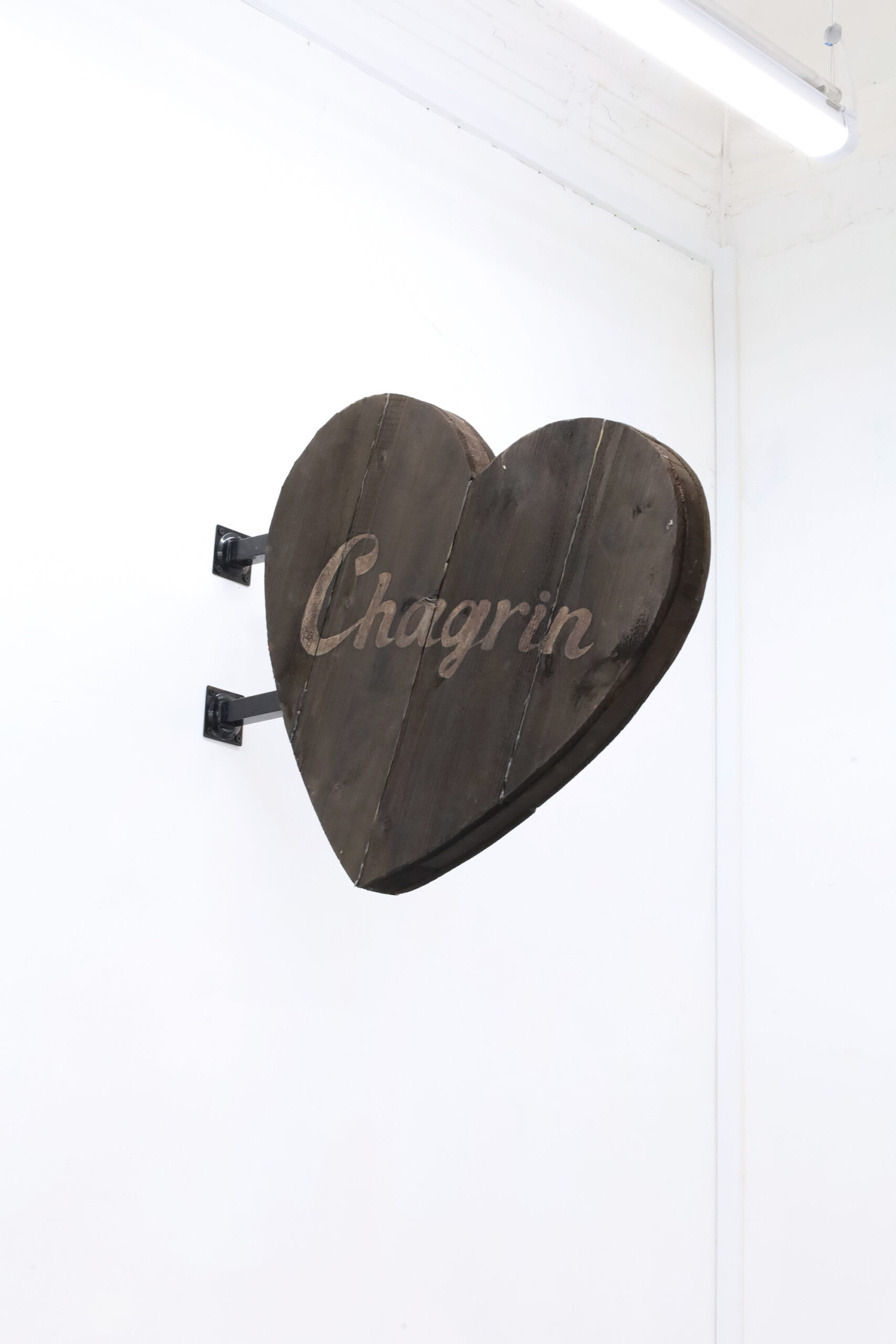
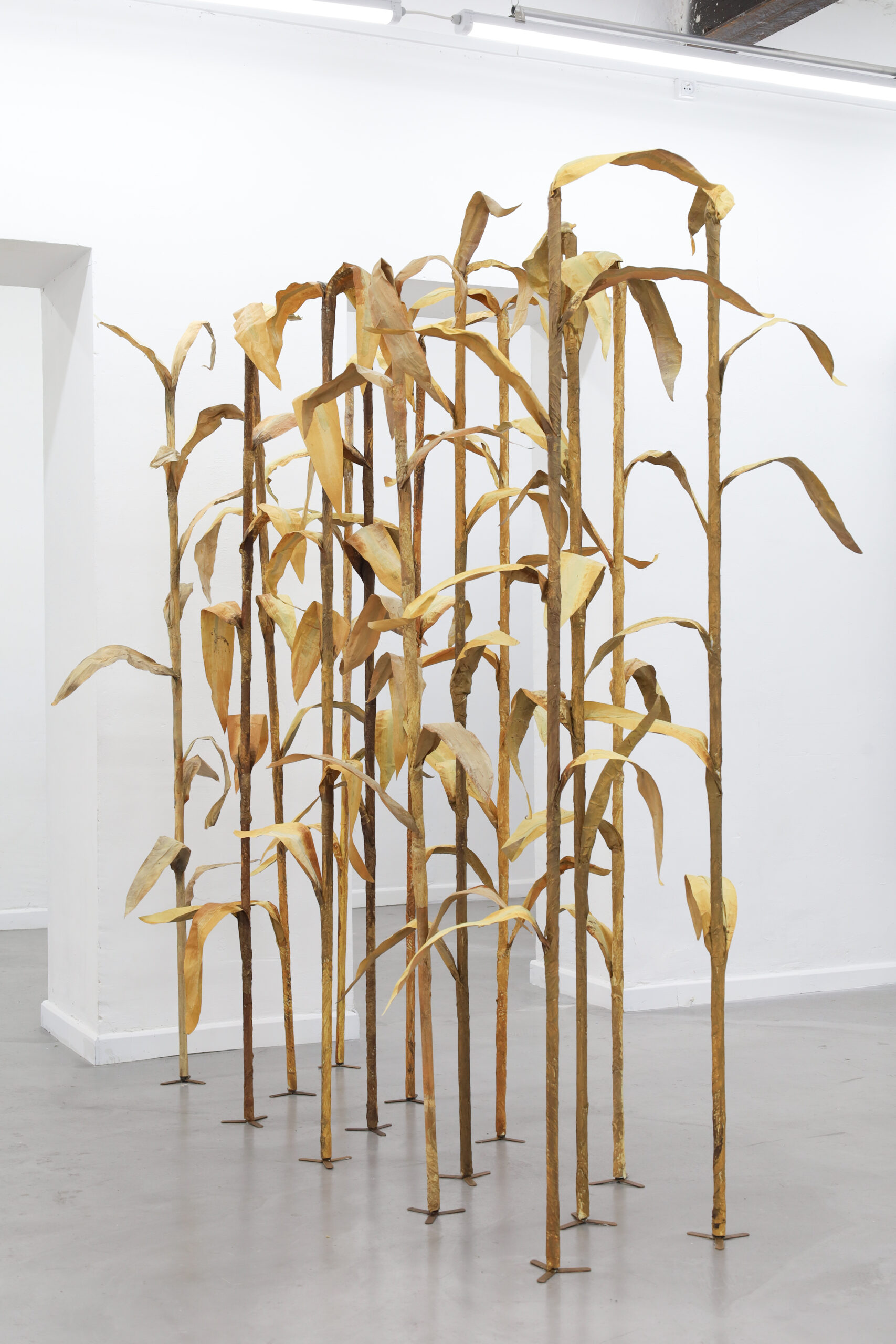
The starting point for ‘Chagrin’ is a short story written by the artist, ‘Avant que les champs ne brûlent’, in which he imagines the story of a homosexual couple wrongly accused of being responsible for a drought. Borrowing from multiple cinematic references — the futuristic westerns Interstellar (Christopher Nolan, 2014) or the Westworld series — the village he depicts, in the middle of cornfields, becomes the contemporary theater of violence and mourning, between homocide and ecocide.
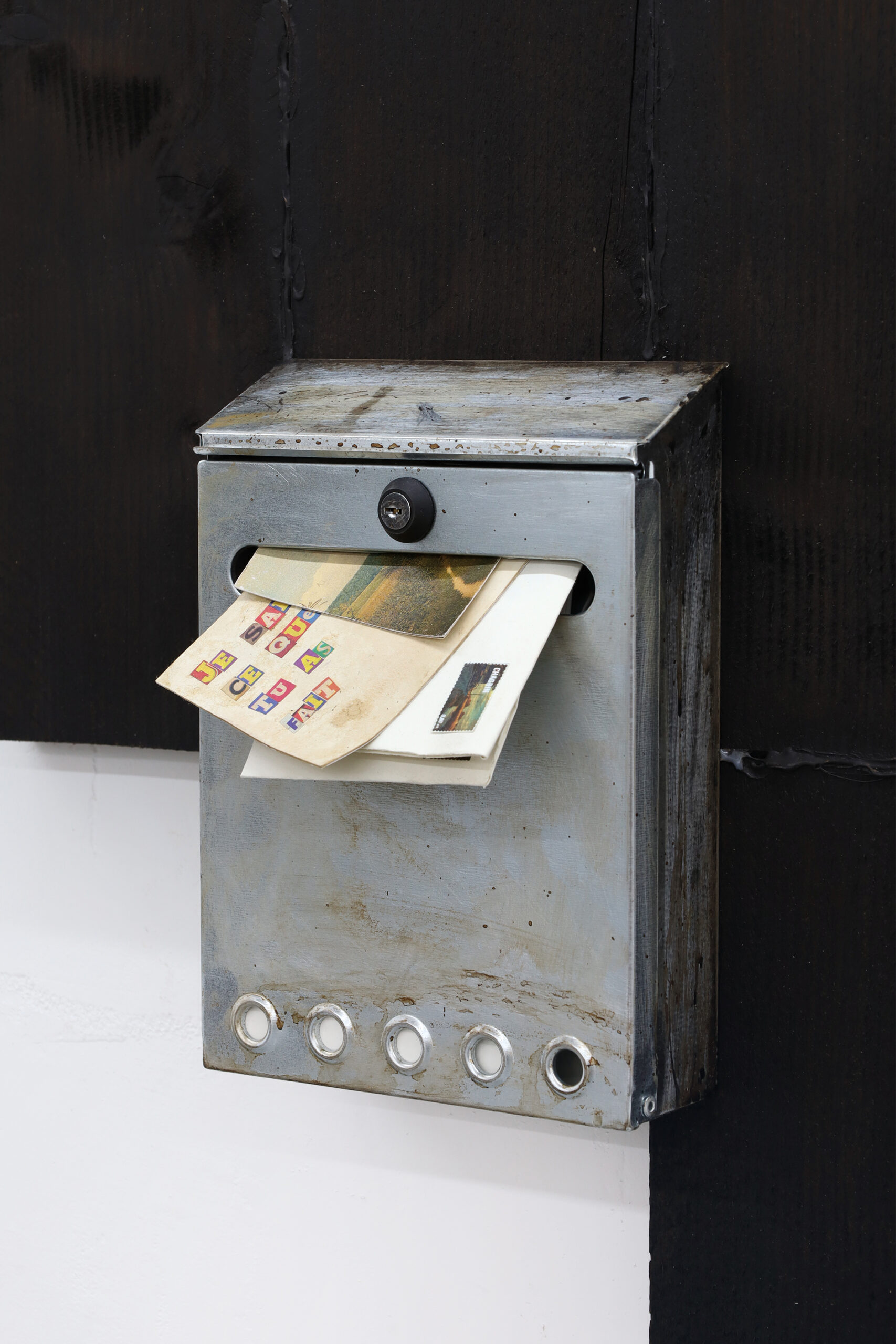
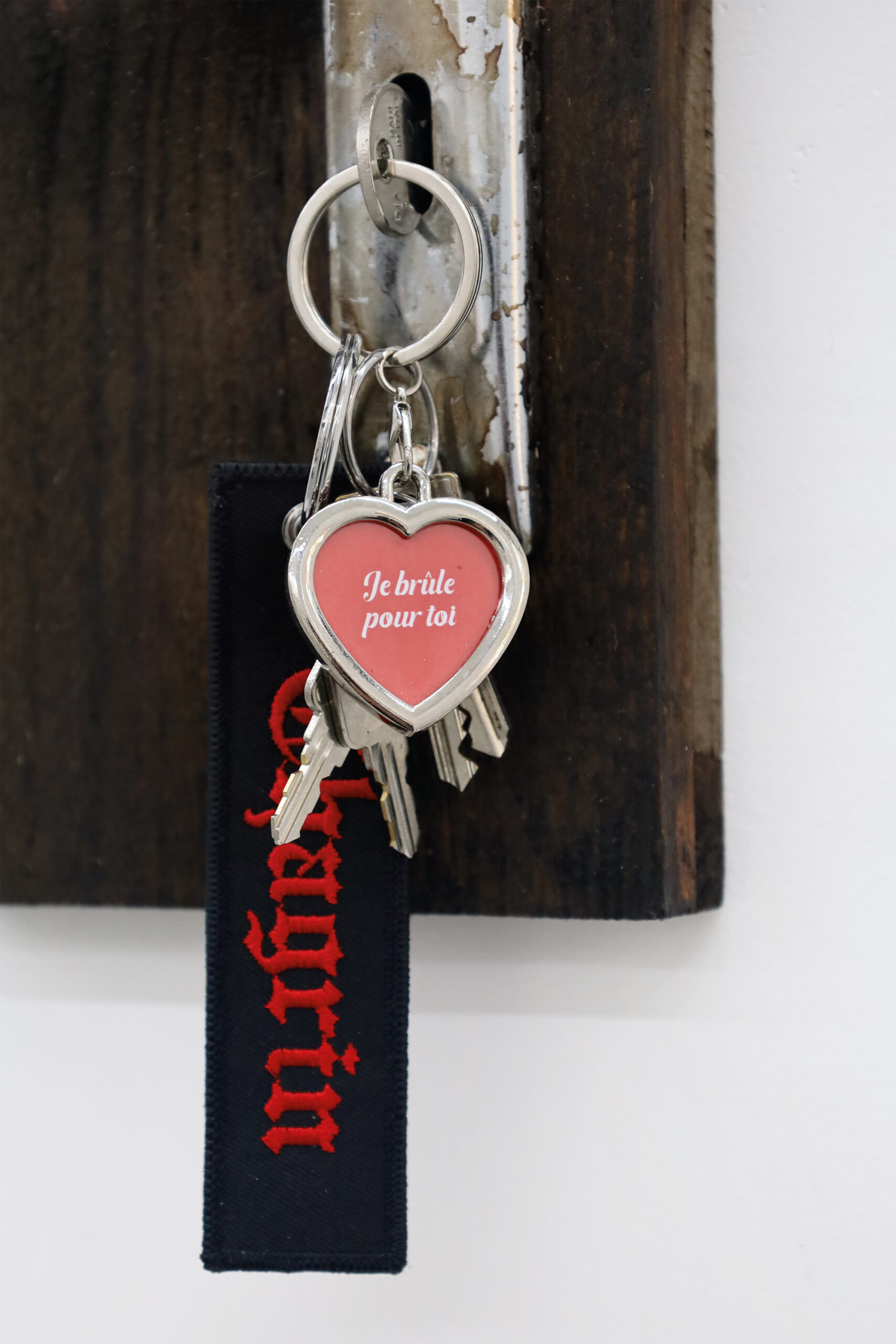
In Je brûle pour toi, 2024 and À tes risques et périls, 2024, he recomposes the elements of the setting in bits and pieces: the facades of the weathered wooden houses, the sign of the bar, the intercom and the mailbox, in which he scatters messages of threat or love. In this way, he combines the aesthetics of 1990s American slashers with the cheesy ambience of romance novels, building dramatic tension in increments.
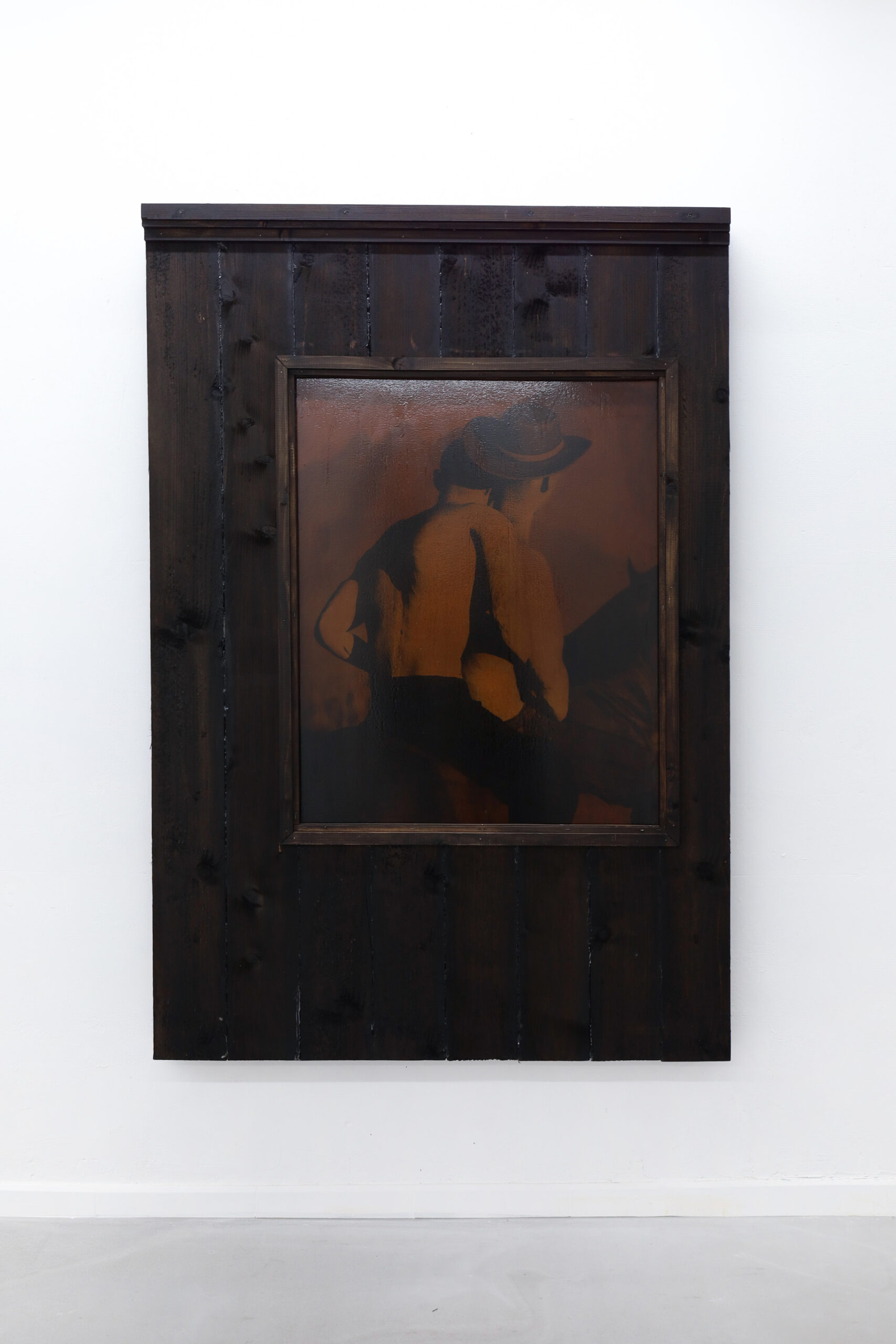
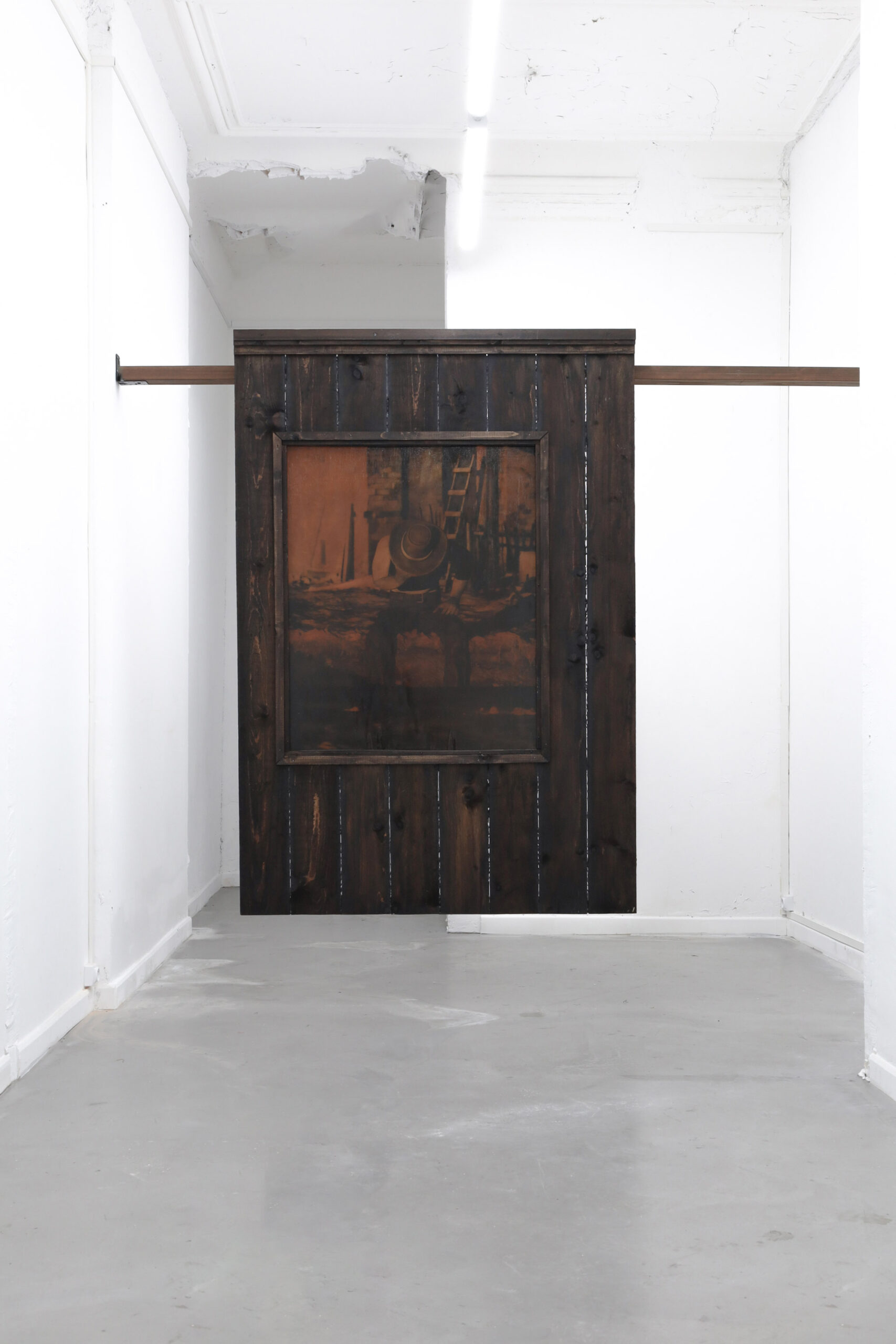
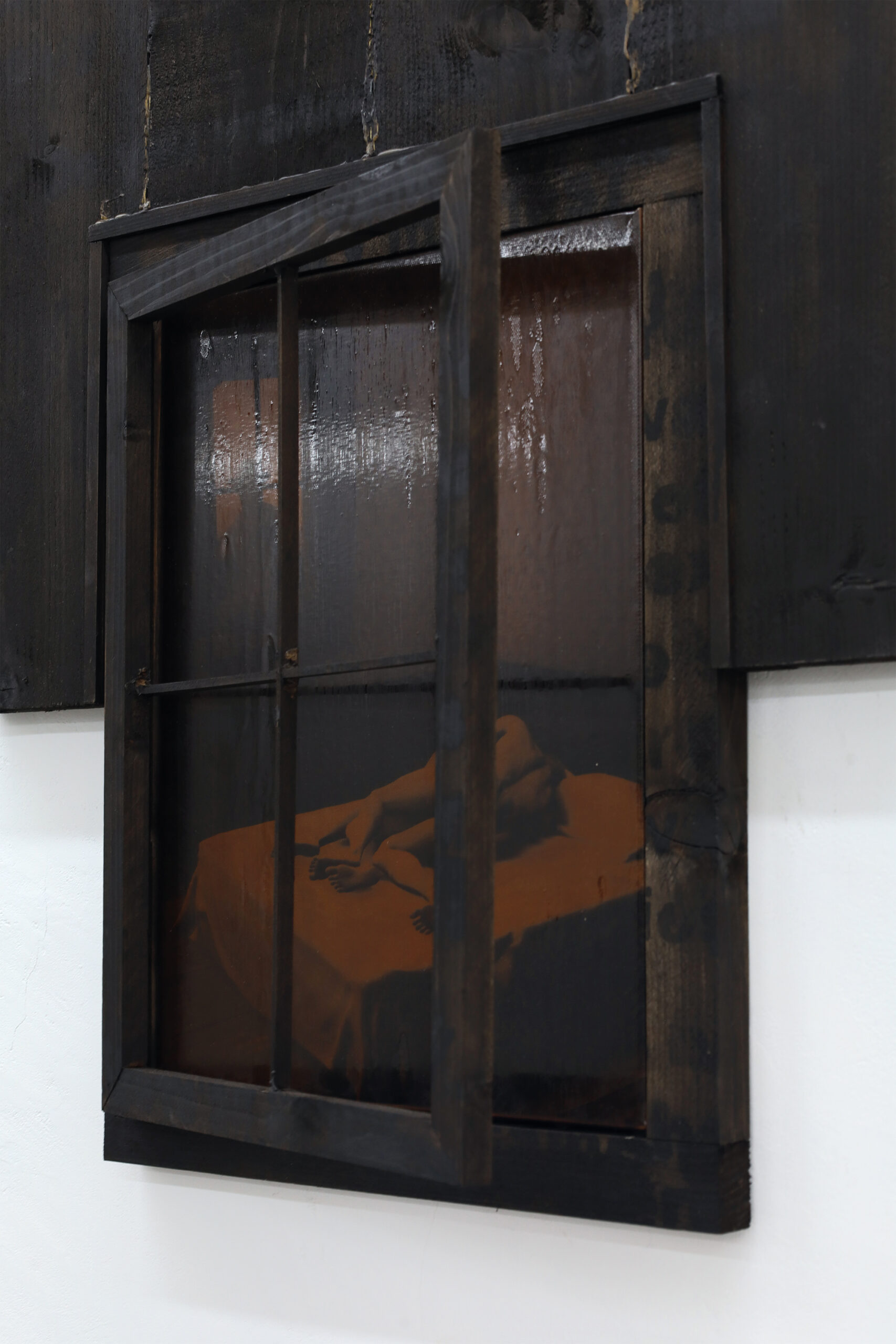
In the course of inlaid canvases, in small windows or between the boards of a barn (Première poignée de terre, 2024), we catch glimpses of sequences from the lives of the two lovers: embrace, sleep, attack, tear and funeral. Through these short glimpses, the artist questions the voyeurism that unfolds in the experience of observation, questioning the cathartic relationship between viewer and image.
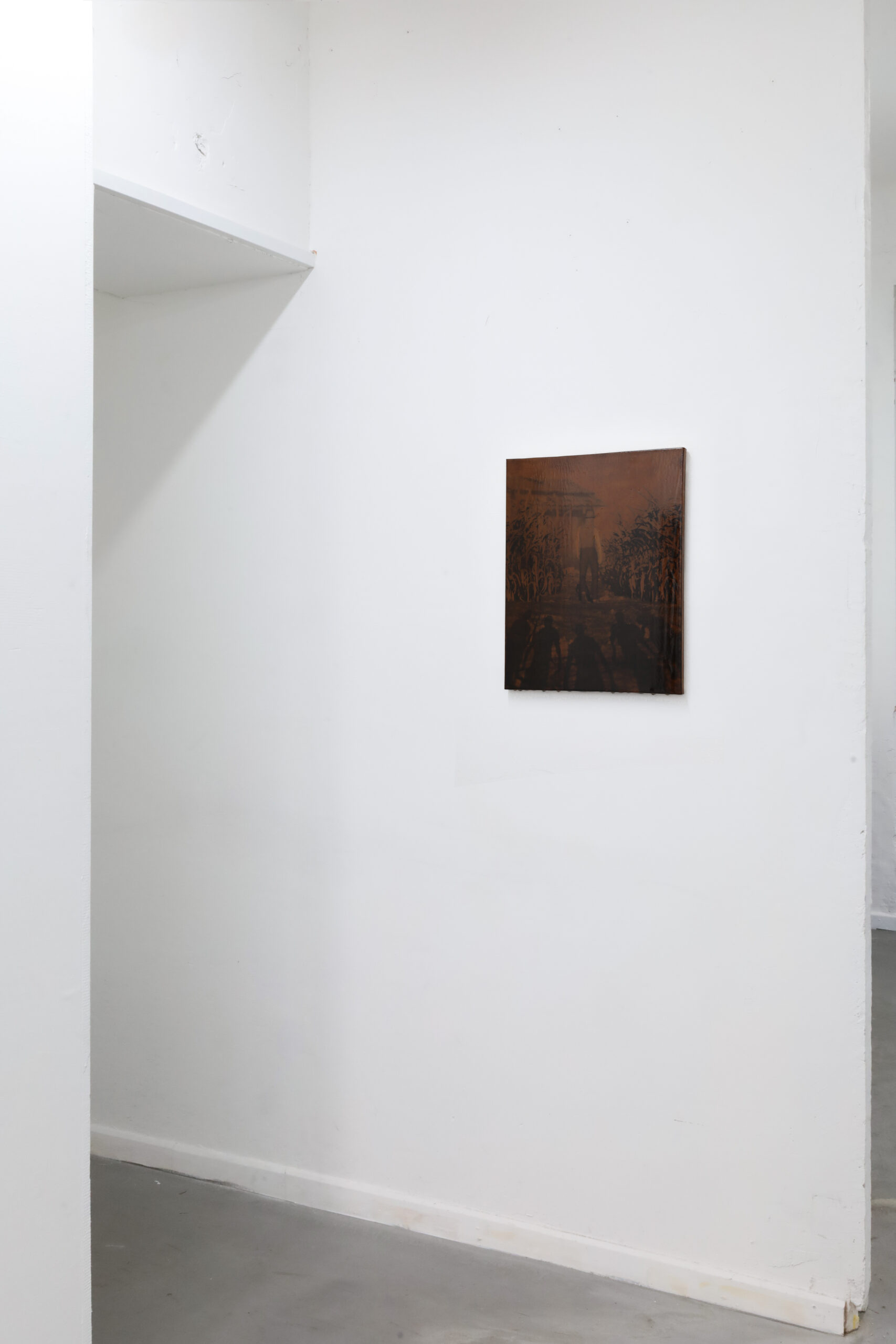
The photographic aesthetic, inherited from video games, leads the representations to frozen, sometimes theatricalized, deliberately exaggerated postures: the hand on the hat of the lonely cowboy, or the shadow of the accusers with brandished pitchforks (La mort est dans le pré, 2024). Varnished with resin, applied to the canvases like a screen, the artist imparts a smooth, glossy texture to the works, like digital images. This material, while adding a tactile and erotic dimension, plays on the idea of the image freezing in a state of desire and secrecy.
Using the figure of the cowboy, Darré takes a queer approach to Hollywood cosmogony, in the manner of The Secret of Brokeback Mountain (Ang Lee, 2005) or Lonesome Cowboys (Andy Warhol, 1968), stories of desire and prohibitions, terrible or parodic. By revisiting this symbolic, heteronormative character as a gay fetish, he questions the existence of minoritized bodies in rural areas and interrogates a white trash social and political dimension. In this way, Darré invites us to enter the territory of fiction, offering a behind-the-scenes experience.